In 1880, there was momentary confusion every time a telephone rang at Belfast’s fire station. Before the firemen could ask the caller about the fire, a more fundamental question had to be addressed — which of the two telephones was actually ringing? The fact there were two phones in the station was not due to a sudden outbreak of pyromania amongst the citizenry of Belfast but a response to the fact that there were two rival, unconnected telephone exchanges in the city. The fire station thus needed a separate connection to each exchange in order to be fully connected to all telephone users1.
This messy situation in Belfast arose because the telephone service, like the initial telegraph services, was born of rival private companies. In a pattern similar to the dawn of the internet in the closing years of the 20th century, initial development of the phone was a constant flux of patent wars, court-room battles, mergers and acquisitions. In 1877, a year after he had filed a patent for his “telephonic device”, a newly-wed Alexander Graham Bell embarked on a year-long tour of Europe with his wife Mabel to promote his new invention2. It might have been an unusual honeymoon choice but as a promotional tactic it was a great success with a company registered in London to sell his invention3.
The full title of Bell’s company was The Telephone Company (Bell’s Patents) Ltd. However, within seven months of Bell being granted his US patent, American Thomas Alva Edison was granted a patent for “acoustic telegraphy”. By 1879 Edison’s invention had also crossed the Atlantic and the Edison Telephone Co of London was formed4. Incidentally, one of its employees was a 22-year old George Bernard Shaw who described his brief employment there as “my last attempt to earn an honest living”3. Bell’s and Edison’s companies battled each other for subscribers in London before merging in May 1880 to form the United Telephone Company (UTC). Thus there was no need for the Fire Brigade in London to have separate phone lines with two rival companies.
Competitors to the United Telephone Company remained, however, and rivalries continued in other cities. One such place was Belfast, where two telephone companies opened for business within a month of each other. The Scottish Telephonic Exchange Company was first off the mark, opening an exchange at Castle Chambers in May 18805, roughly at the spot now occupied by the ladies’ lingerie section of TK Maxx. Meanwhile the newly-formed UTC, which had opened for business in Dublin in April, expanded north to open its Belfast telephone exchange at 3 High Street in June 1880. Its adverts warned testily “that legal proceedings will be taken against all persons infringing their Patent”6. The Scottish company stole a march on its rival by offering three months free rental to the first 50 customers7, a marketing tactic which was rediscovered in recent years by competing telephone companies. Meanwhile the UTC advertised that the Fire Brigade was now connected, reminding prospective customers that “a minute in the early stage of a fire is worth a hundred later on”8.
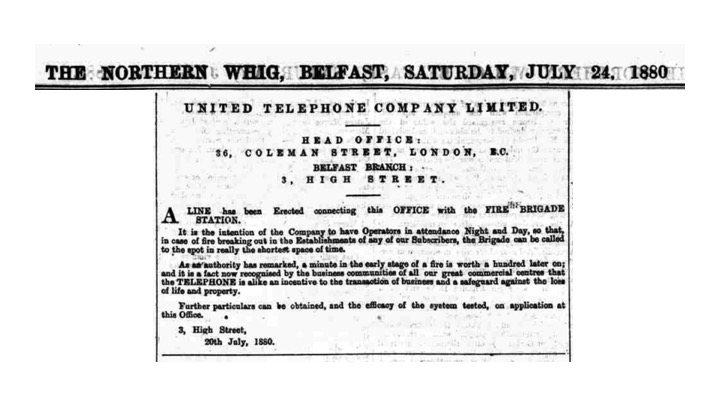
With no interconnection between the two rival systems, anyone who wanted to be fully connected was required to rent a line from both companies. By August the Belfast Fire Brigade thus had two telephones9, one line connected to the Scottish Telephonic Exchange Company and the other to the United Telephone Company. At least neither of the rivals charged Belfast Corporation for their phones1.
The duplication in Belfast was solved when the Scottish company was merged with its rival in July 1881, presumably reducing confusion at Belfast’s fire station. Perhaps to make amends for the initial telephonic chaos, the newly-united National Telephone Company allocated the Fire Brigade the number Belfast 110.
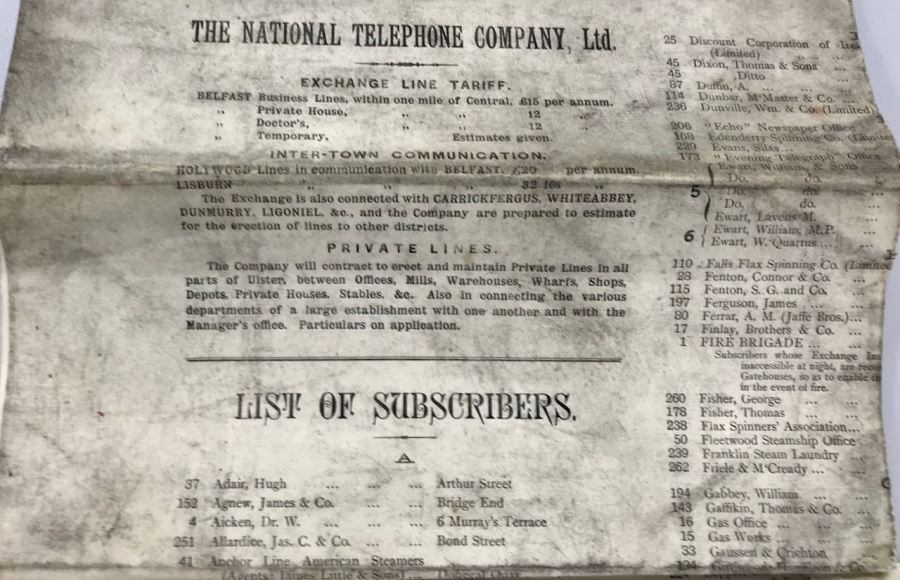
Eleventh night bonfires might make life busy for Belfast’s firemen, but at least they no longer have to figure out which phone is ringing at the station.
This is an excerpt from my book project, Connecting a Nation. It tells the story of the pivotal role that telecommunications have played in the development in Ireland from 1852 to the present. Feedback is welcome – especially from publishers !
References
- Public Record Office of Northern Ireland, Minute Book of the Town Council 1879-1882, LA/7/2/EA/14.
- Huurdeman, Anton A. The worldwide history of telecommunications. 2003, Hoboken, N.J.: Wiley-Interscience.
- Litton, A.J. The Growth and Development of the Irish Telephone System. Journal of the Statistical and Social Inquiry Society of Ireland, 1962, XX: 79-115.
- Chapuis, R.J. and Joel, A.E. 100 Years of Telephone Switching. 2003: IOS Press.
- “Scottish Telephonic Exchange Limited”, Northern Whig, 01/05/1880
- “The Telephone Company Limited”, The Northern Whig, 01/05/1880
- Flynn, R. The Development of Universal Telephone Service in Ireland 1880 – 1993. 1998, Dublin City University: Dublin.
- “United Telephone Company Limited ”, Northern Whig, 24/07/1880
- Cullen, F. J. . Local government and the management of urban space: a comparative study of Belfast and Dublin, 1830-1922. 2005, NUIM Maynooth.
- Public Record Office of Northern Ireland, The National Telephone Company Limited, D2194/106/1.
 Deryck Fay